What challenge was the client facing, and why did it matter?
The bank was using threat data from multiple sources, but its practical usefulness did not always match the specifics of a banking environment. The core challenge was not data volume, but a low signal-to-noise ratio – generic commodity IoCs lacked financial sector context, overwhelming SOC analysts and driving severe alert fatigue.
In practice, high false-positive rates required manual analyst validation, creating operational bottlenecks and delaying proactive threat hunting across SIEM and SOAR platforms. Another important challenge was the lack of flexibility in working with the data. The client needed a solution that would allow the scope of information to be narrowed by source, risk level, or time, instead of forcing teams to work with a full, unfiltered stream of indicators.
Key challenges:
- limited threat context relevant to the financial sector
- the need to better align threat intelligence with the realities of banking
- excessive noise making day-to-day analysis more difficult
- the need for additional validation of some information by internal security teams
- the need for a selective approach to data instead of consuming a full stream of indicators
- the need for efficient deployment and alignment with existing security processes
What was implemented, and how did it work in practice?
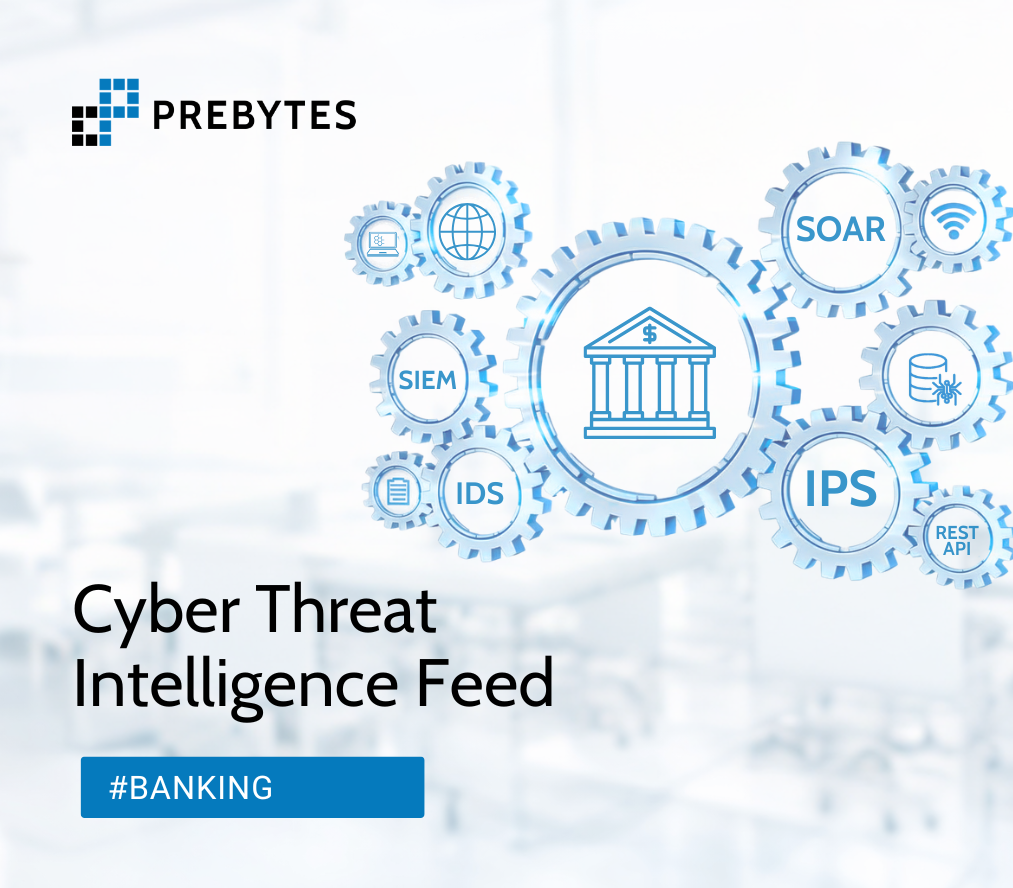
The bank implemented Cyber Threat Intelligence Feed (CTI Feed) as an additional source of threat data supporting its existing security processes. The key value of the solution was not only the quality of the information itself, but also its usefulness in the day-to-day work of security teams.
An important part of that value comes from the work of PREBYTES SIRT (Security Incident Response Team), which handles and analyzes incidents and monitors threats relevant to financial institutions. As a result, the feed delivers human-validated, curated threat telemetry grounded in active financial attacks, rather than raw, unverified global OSINT dumps.
At the same time, the solution is backed by a broad data acquisition infrastructure. CTI Feed aggregates intelligence from multiple sources, including more than 100 active web crawlers, daily processing of over 350 million domains, and analysis of more than 6 million spam messages per month. This provides access to a broad stream of threat data without the need to build and maintain an internal acquisition infrastructure.
In practice, this meant access to information that was current, verified, and selectively filtered. Data can be filtered by source, risk level, and time range, making it easier to align the scope of intelligence with specific operational needs and reduce the inflow of low-value information.
Another advantage was the ability to work with both current and historical data. Native delivery via STIX 2.1 / TAXII 2.1 alongside REST API, JSON, and CSV enabled friction-free ingestion into existing SIEM, SOAR, and TIP architectures.
What were the results, and what changed in day-to-day operations?
After implementation, the bank gained a threat intelligence source that was better aligned with its actual operational needs. This translated not only into greater usefulness of the data itself, but also into more efficient work by security teams, faster identification of threats, and better support for protective and preventive actions. High-fidelity, curated IoCs drastically reduced Tier-1 SOC triage time, freeing FTE resources to focus on high-priority threat hunting and incident response.
In practice, this meant less noise, greater control over the scope of the information being used, and better application of threat intelligence in day-to-day security processes. The feed became more useful in supporting the organization’s protection against incidents and their consequences, as well as in activities aimed at earlier threat detection and reducing operational risk.
Results after implementation:
- threat intelligence better aligned with the needs of the financial sector
- Audit-ready compliance alignment with EU DORA, UK NIS regulations, and FCA operational resilience expectations for threat monitoring
- access to data with greater operational value
- reduced informational noise
- greater control over the scope of ingested information
- more effective use of threat intelligence in the daily work of security teams
- efficient implementation process and operational cooperation
- flexible use of data thanks to availability in CSV, JSON, STIX, TAXII, and XML formats